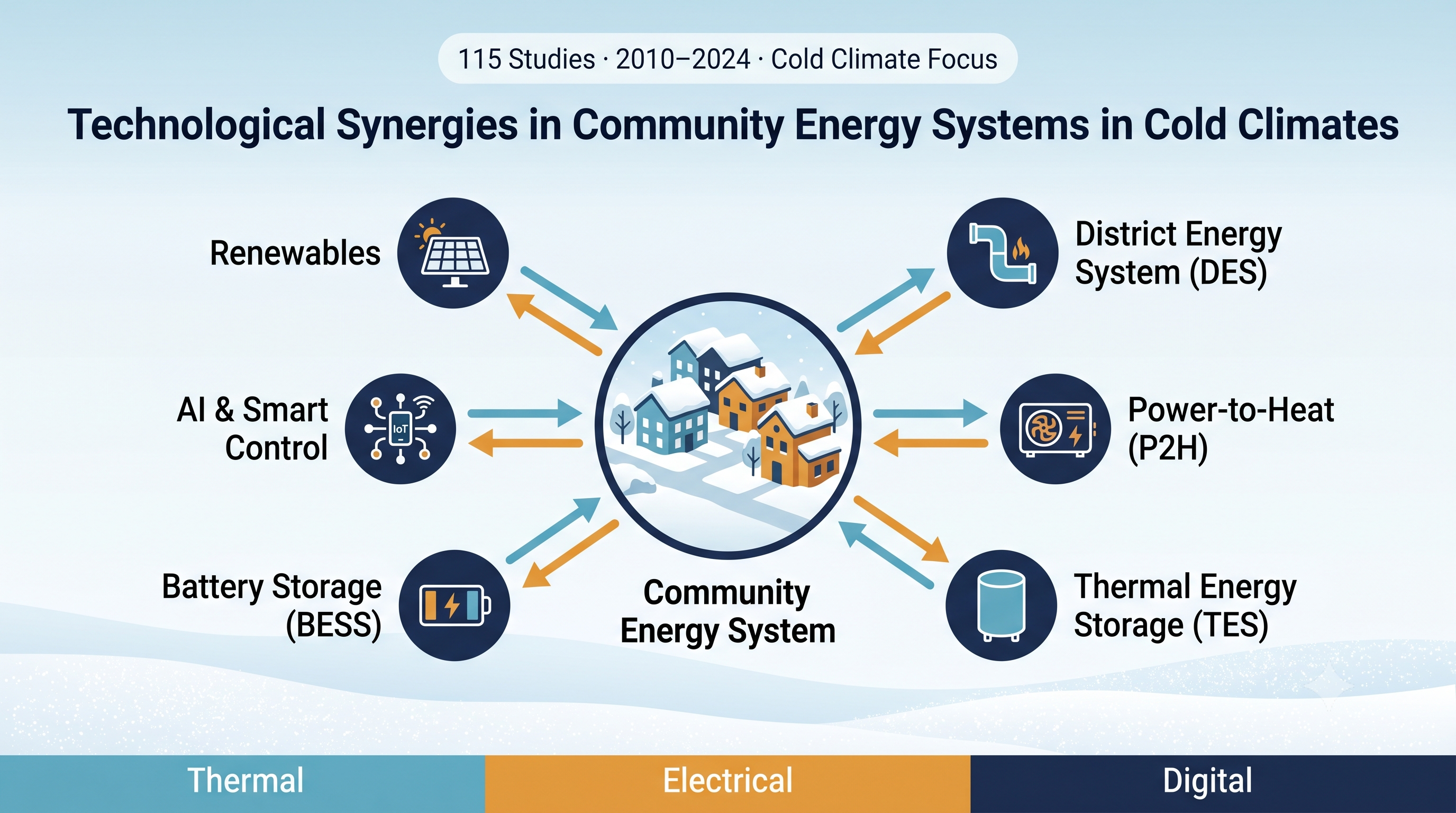
This review systematically synthesizes technological synergies within a Community Energy System (CES), emphasizing cold-climate contexts where heating-dominant demand profiles and strong seasonality create distinct operational challenges. Drawing on 115 studies (2010–2024), the paper explores how integrated thermal, electrical, and digital infrastructures support net-zero and climate-resilient communities in regions with substantial heating requirements. Thermal–electrical coupling emerges as a foundational mechanism in cold climates, where heating loads dominate annual energy demand and drive winter peak constraints. Power-to-Heat (P2H) systems, cold-climate heat pumps, and hybrid configurations combining Thermal Energy Storage (TES) with Battery Energy Storage Systems (BESS) enable multi-timescale flexibility, allowing renewable energy to be shifted from hours to seasons. District Energy Systems (DES) act as a thermal backbone, enabling this integration across extended heating seasons and transforming thermal demand into a grid-balancing resource. Digital technologies further enhance system coordination under variable climatic conditions. Artificial Intelligence (AI), the Internet of Things (IoT), and Advanced Metering Infrastructure (AMI) support real-time optimization, demand response, and cross-vector control within Renewable Energy Communities (RECs) and Virtual Power Plants (VPPs). At the system level, decentralized architectures — including microgrids, Non-Wire Alternatives (NWAs), and peer-to-peer (P2P) trading — strengthen resilience by maintaining thermal and electrical continuity during grid disruptions. The review concludes with policy, governance, and research recommendations to enable scalable, equitable, and climate-responsive CES deployment in heating-dominated regions.
- Thermal–electrical coupling via P2H and TES is the foundational synergy in cold climates, enabling renewable energy to be shifted across timescales from hours to full seasons — directly addressing the cold-climate "seasonal paradox."
- District Energy Systems (DES) act as a thermal backbone, transforming community heating demand into a grid-balancing resource and achieving up to 65% GHG reduction in fifth-generation configurations.
- AI, IoT, and AMI digital layers enable real-time cross-vector coordination within Renewable Energy Communities and Virtual Power Plants, unlocking demand flexibility and high renewable penetration.
- Decentralized architectures (microgrids, P2P trading) provide passive survivability — maintaining thermal and electrical continuity during extreme cold events and grid disruptions — identified as a critical design priority for northern latitudes.
Community energy systems · District energy systems · Thermal energy storage · Demand response · Grid integration · Renewable energy communities · Net-zero transition · Cold climates · Power-to-Heat · Battery storage
Hachem-Vermette, C., Iseri, O. K., Subedi, A., Hassan, A. N. M., McNevin, C., & Razavi, F. (2026). Technological synergies in community energy systems in cold climates. Energies, 19(5), 1198. https://doi.org/10.3390/en19051198