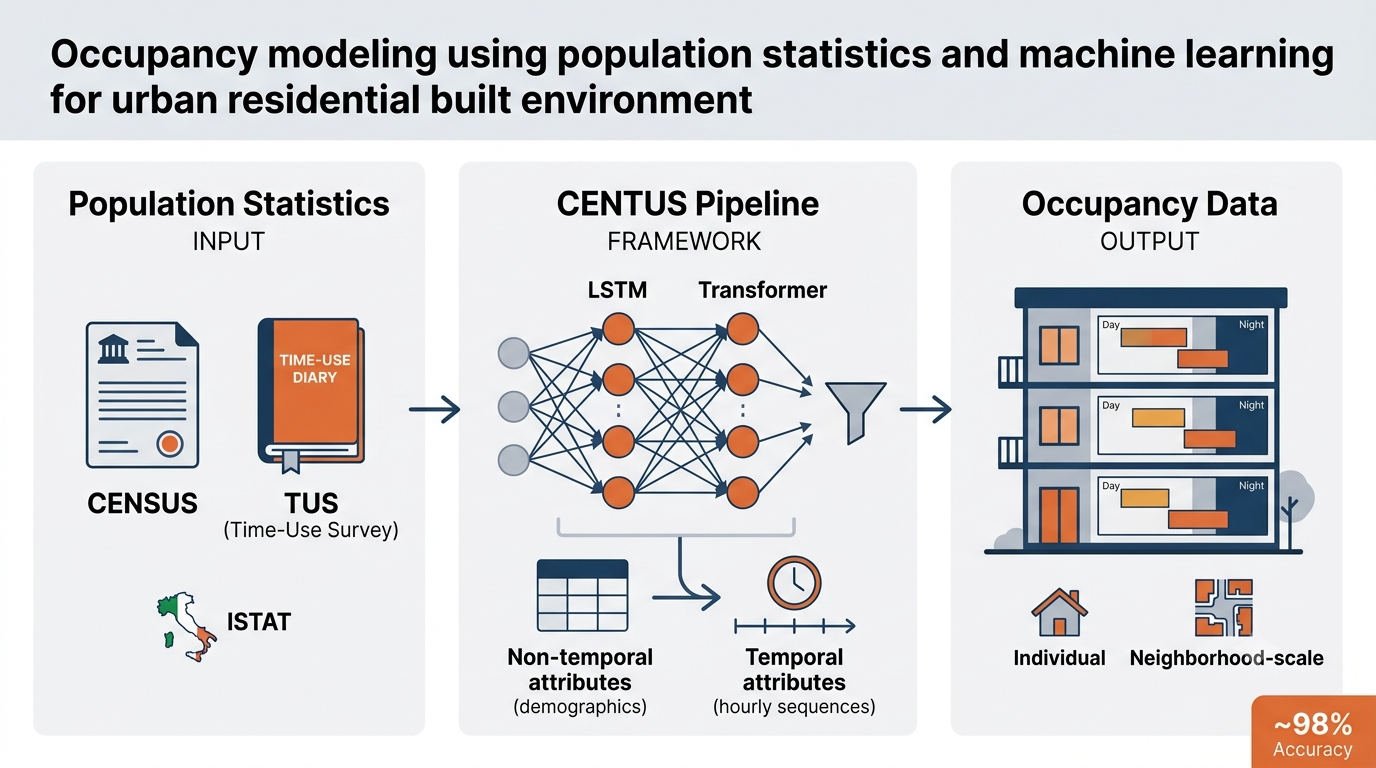
Occupancy modeling aims to represent the diversity of occupant behavior in buildings; accurate modeling of occupancy is therefore essential for understanding household dynamics and energy-related interactions in residential buildings, as well as for their use in building performance applications. The central contribution of this research is a novel, data-driven methodology for generating high-fidelity occupancy data called CENTUS. Our approach synthesizes official population statistics from ISTAT with nuanced behavioral patterns analyzed using advanced deep learning architectures (LSTM and Transformer). This framework enables the comprehensive, year-long classification of household occupancy across both temporal and non-temporal attributes. Through unified multitask learning that integrates sequential columns with demographic attributes, these models can simultaneously classify multiple occupancy attributes with superior accuracy and broader coverage compared to traditional deterministic and stochastic approaches. Our approach delivers three key advantages: ensures privacy protection through ethically sourced public institutional data; enables cross-national compatibility; and supports flexible scaling from individual residential units to neighborhood-level analysis via multiple modeling strategies including Argmax classification, SoftMax distributions, and temperature-controlled sampling.
- The CENTUS framework fuses two ISTAT datasets — CENSUS (Housing & Population) and TUS (Time-Use Survey) — into a unified, privacy-preserving occupancy dataset of 200,000+ entries spanning all of Italy.
- LSTM and Transformer deep learning models achieve ~98% accuracy in classifying multi-dimensional occupancy attributes, substantially outperforming conventional higher-order Markov chain baselines (0.691 accuracy).
- Multitask learning jointly classifies non-temporal demographic attributes with temporal behavioral patterns (Occupant Activity, Presence, Co-Presence), enabling richer and more realistic occupancy profiles.
- The methodology is globally transferable across all HETUS-participating nations and supports seamless scaling from individual households to neighborhood-level urban building energy simulations.
Building occupancy modeling · Population statistics · Time-series datasets · Data-driven models · Deep learning · LSTM · Transformers · Building performance modeling · UBEM
Iseri, O. K., Dino, I. G., & Kalkan, S. (2026). Occupancy modeling using population statistics and machine learning for urban residential built environment. Energy and Buildings, 357, 117155. https://doi.org/10.1016/j.enbuild.2026.117155